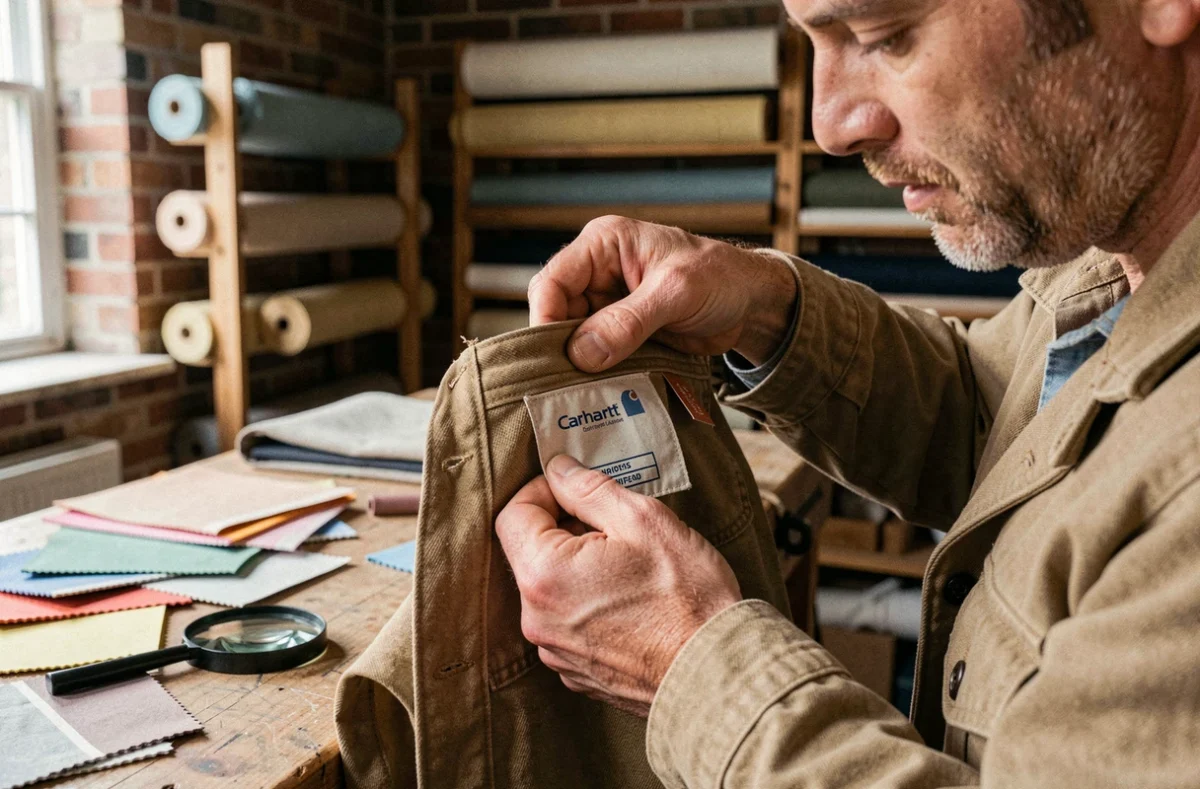
You come across a Carhartt jacket at a bargain price in a flea market, on a marketplace, or in a consignment shop. The fabric seems decent, the logo is there, and the color leans towards that characteristic ochre. Before paying, you need to check a few specific points because Carhartt counterfeits have significantly improved in recent years.
Carhartt Product Reference: The Test That Counterfeiters Fail
Most authentication guides start with the patch sewn on the chest. This is useful, but recent counterfeits replicate this patch quite well. The most reliable check begins with an element that counterfeiters almost always overlook: the product reference and the official associated sheet.
Each Carhartt model has a reference number (style number) printed on the inner label. This number corresponds to a sheet on the official Carhartt website, detailing the fit, fabric composition, weight of the canvas, and sometimes the country of manufacture. When comparing this information with the garment in hand, inconsistencies become glaringly obvious on a fake.
A concrete example: the B01 pants, a classic in Carhartt workwear, have documented composition and country of manufacture. If the garment’s label states a different material or a fit that does not match the official sheet, you can dismiss the piece. This cross-check between the physical label and the online sheet is a reflex to adopt systematically, even when you can authenticate a Carhartt garment on Saint-Malo using other complementary methods.
Care Label and Carhartt Holographic Strip: Reading the Right Clues
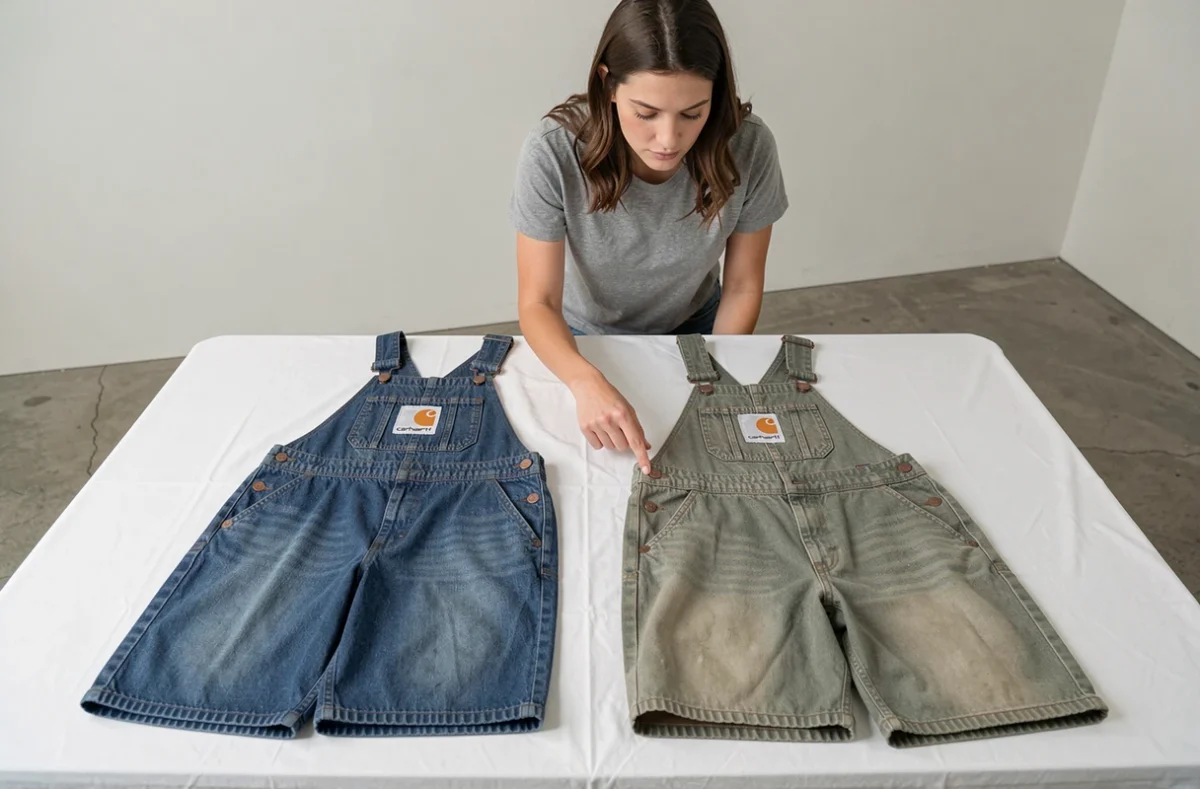
The inner care label contains several verifiable pieces of information. On recent pieces, there is a holographic strip integrated into the label. This detail remains difficult for counterfeiters to reproduce because it requires a specific printing process.
Some points to check on this label:
- The style number must be legible and correspond to an existing model in the Carhartt catalog (verifiable online in seconds).
- The stated fabric composition must match the model. A chore coat made of 100% cotton duck canvas that lists a synthetic blend on the label is problematic.
- The country of manufacture deserves attention, but the mention “Imported” is normal on many models. The official Carhartt sheets themselves indicate “Imported” or “Made in USA of Imported Parts” depending on the references. This is not a counterfeit signal in itself.
Feedback varies on the systematic presence of the holographic strip. On vintage pieces or certain older ranges, it may be absent without the garment being fake. It’s an additional clue, not a verdict on its own.
Carhartt Stitching and Buttons: What the Touch Reveals
A genuine Carhartt is distinguished by double or triple stitching, regular and tight. Counterfeits often feature single, irregular stitching or threads that stick out. This check requires no tools, just turning the garment inside out and observing the reinforcements at stress points (armholes, pockets, inseam on pants).
Metal buttons are another reliable marker. On an authentic piece, the name “Carhartt” is engraved in the metal, with a clear relief to the touch. A button that is simply printed, with lettering that fades with friction, betrays a fake. Zippers follow the same logic: Carhartt zips glide smoothly and often bear the manufacturer’s mark (YKK on many models).
The Duck Fabric Test and Carhartt Brown Color
The duck canvas used by Carhartt has a sufficiently dense weight that you can feel it immediately in hand. A fake generally uses a thinner, softer fabric that does not stand up when placed on a table.
The Carhartt Brown shade, this characteristic deep ochre, is notoriously difficult to reproduce. Counterfeits often lean towards a brown that is too light or too orange. Comparing with a photo of the official color on the Carhartt website helps to make a decision.
Carhartt Technical Features: An Underutilized Angle of Authentication
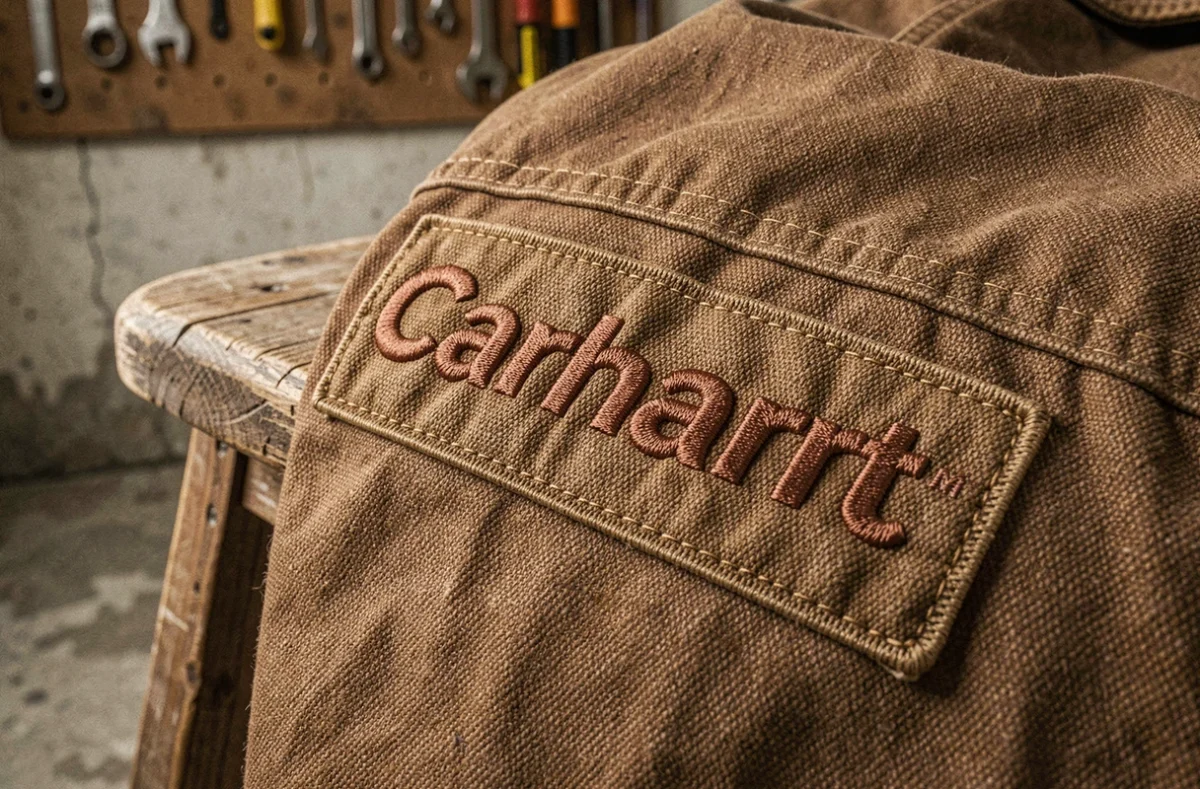
Beyond the visual aspect, some Carhartt garments meet documented technical standards. The flame-resistant (FR) ranges carry specific certifications (ASTM or NFPA standards) noted on the label. Assigning a model a certification that is absent from its official sheet is a clear warning signal.
The type of cotton used is also an indicator. Carhartt sometimes specifies the use of ringspun cotton on certain lines. A label that mentions this type of fiber on a model where Carhartt does not use it indicates either a counterfeit or an swapped label, both problematic cases.
Carhartt US and Carhartt WIP: Two Authentic Lines Not to Be Confused
Carhartt US (original workwear, based in Dearborn) and Carhartt WIP (Work In Progress, European fashion line with a distinctive square logo) are two legitimate entities. Sizes differ (US workwear uses the W x L format, WIP follows European sizing), as do the cuts. Confusing the two does not mean encountering a fake, but buying a WIP piece at the price of a vintage US (or vice versa) remains a costly mistake.
The safest way to recognize a genuine Carhartt garment is to cross-check several verifications: product reference, label, stitching, buttons, and fabric. A fake may correctly imitate one or two of these elements, but the accumulation of consistent details across all these points distinguishes an authentic from a counterfeit. When just one element does not match, it’s better to walk away.