
Automotive transport in 2024 is structured around regulatory constraints that redefine the technical priorities of manufacturers and fleet managers. Three main areas are attracting attention: certified cybersecurity, charging infrastructure under the AFIR regulation, and bidirectional charging as a lever for energy integration. Here, we detail the points that are concretely changing the sector’s decision-making.
Automotive Cybersecurity: UN Regulation R155 as a Homologation Condition
The cybersecurity of connected vehicles is no longer an optional feature. UN Regulation R155 makes it a regulatory condition for market entry. Any manufacturer wishing to homologate a new model must demonstrate compliance with its Cybersecurity Management System (CSMS) even before the technical certification phase.
This obligation changes the game for equipment manufacturers. Embedded components (electronic control units, connectivity modules) must integrate intrusion detection mechanisms and secure update capabilities from the design stage. The integration cost is passed along the entire value chain.
We observe that companies outsourcing their connected modules must now audit their suppliers on this aspect. Equipment not compliant with R155 blocks the homologation of the complete vehicle. Chinese players exporting to Europe are particularly exposed to this constraint, as R155 compliance applies regardless of the manufacturer’s origin.
To keep up with the evolution of these regulatory and technical issues, the Auto World transport site regularly shares sector analyses related to mobility and connected vehicles.
AFIR Regulation and Charging Infrastructure on European Corridors

The European AFIR regulation, applicable since April 13, 2024, mandates a network of charging stations every 60 km at most on certain corridors of the trans-European network. This is not a recommendation: it is a deployment obligation that member states must meet with a precise timeline.
Price transparency becomes a legal requirement, not a commercial argument. Charging station operators must display prices clearly and allow payment without a subscription. New contactless payment obligations will come into effect on January 1, 2027, for certain charging points of at least 50 kW.
For fleet managers, AFIR changes the profitability calculation of electric vehicles over long distances. The certainty of a dense charging network on main routes reduces the operational risk that hindered the transition. Road transport companies can integrate these corridors into their route planning with an unprecedented level of reliability.
What AFIR Changes for Corporate Fleets
- The cost of charging becomes comparable from one operator to another due to the transparency requirement, facilitating budget projections on the TCO of electric vehicles.
- Payment without a subscription eliminates dependence on proprietary networks and simplifies the administrative management of multi-brand fleets.
- The guaranteed network every 60 km on targeted corridors removes the main logistical barrier to the adoption of electric trucks and vans on major European routes.
Bidirectional Charging V2X: Technology Ready, Ecosystem Under Construction
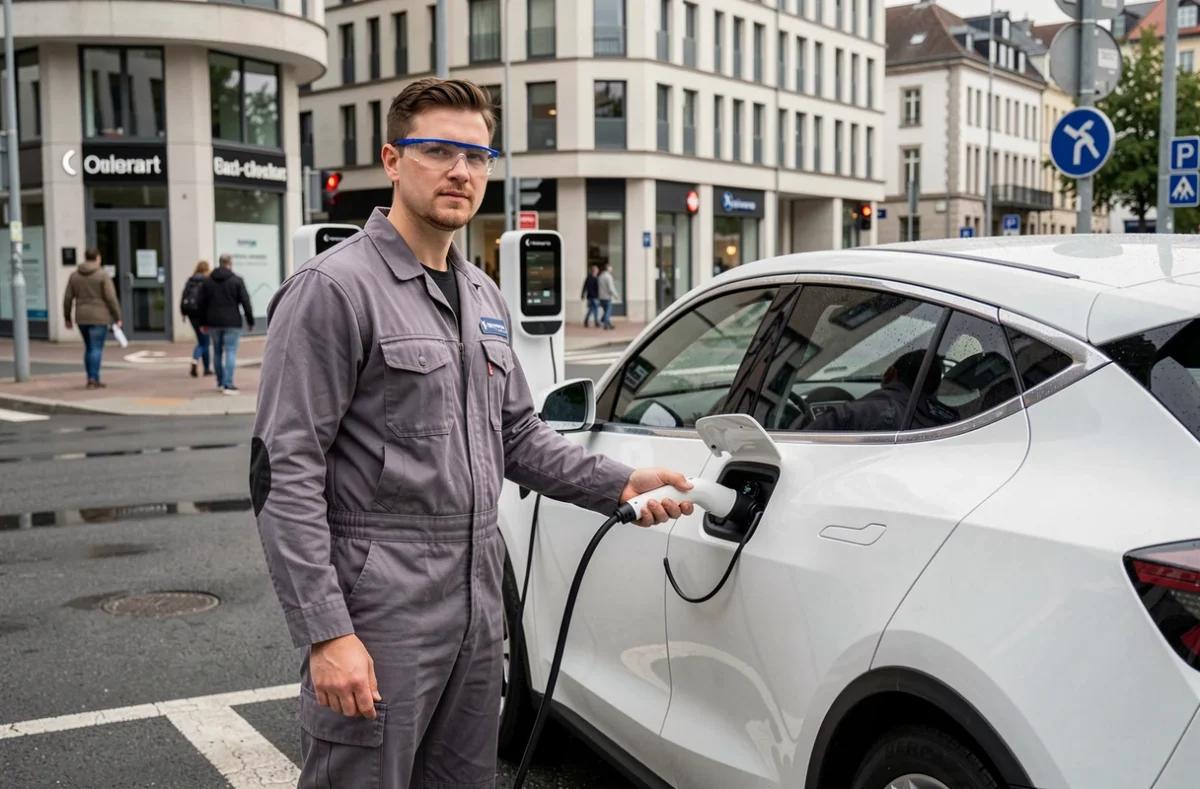
Bidirectional charging (V2X) allows an electric vehicle to inject energy back into the grid, a building, or another vehicle. Commercial offers have existed since 2024, and ISO 15118-20 and OCPP 2.1 standards are gradually structuring interoperability between vehicles, charging stations, and network managers.
The main hurdle remains interoperability. A V2G (vehicle-to-grid) compatible vehicle from one manufacturer does not necessarily communicate with the charging station of another operator. Communication protocols are evolving, but we recommend that fleet managers verify the exact compatibility of vehicle-station pairs before any investment.
Concrete Use Cases for Businesses
A fleet of vehicles parked overnight at an industrial site represents a mobilizable storage capacity. During peak pricing periods, injecting energy back into the building reduces the electricity bill. This model assumes an energy management system (EMS) capable of managing charge and discharge cycles without degrading the batteries.
The accelerated degradation of batteries remains a major point of vigilance. Manufacturers offering V2X generally incorporate cycling limits into their warranty. A fleet manager must compare the net energy gain to the additional wear over the battery pack’s lifespan.
Non-Exhaust Particles and Electric Vehicles: A Regulatory Blind Spot
Electric vehicles eliminate exhaust emissions. However, they do not eliminate particles from tire and brake abrasion. The higher weight of batteries even exacerbates tire wear compared to an equivalent thermal vehicle.
This issue is the subject of standardization work in Europe. Automotive manufacturers are investing in systems to capture brake particles and in low-abrasion tire materials.
For fleets, the choice of tires becomes a full-fledged environmental criterion. Companies subject to ESG reporting obligations will need to incorporate these non-exhaust emissions into their carbon footprint, which alters the selection criteria for vehicles and equipment.
The automotive market is going through a phase where regulatory compliance weighs as much as technical performance in purchasing decisions. Fleet managers who anticipate the AFIR, R155 requirements, and future standards on non-exhaust particles secure their fleet over a horizon of five to seven years rather than facing costly compliance measures afterward.